Currency & Digital Payments
2026 Tourist Update: The average Indian carries very little cash today. Instead, we rely on the Unified Payments Interface (UPI) system to transact using our phones, mostly. Since its introduction in 2016, it has become the backbone of payments in India. Everything from a few rupees to a few thousand (the range of everyday transaction values) is accomplished through UPI. 85% of retail transactions today use digital payments.
While Indians have many options, the UPI One World prepaid wallet is the best way for you, as a foreign traveller, to use digital currency in India. More info: the NPCI UPI One World Guide and the Wise Guide to UPI for Foreigners.
Bottom line: download the phone app (e.g. CheQ, Mony), complete Know Your Customer (KYC) verification with your passport and visa, and add funds using your international credit or debit card to the wallet. Then you can pay or receive money anywhere in India with your phone's digital wallet.
Note: in some remote parts of the country, it's still better to carry some cash. I'd say Rs. 5,000 is enough for a couple of days.
The Indian Rupee (International Currency Code: INR) is the official currency in India. Reserve Bank of India (RBI) controls the issue of the currency. Rs. is the common symbol for INR. One Rupee is equal to 100 paise. The singular for paise is paisa. Sometimes it is referred to as the Naya (new) Paisa.
Rupee is derived from the root Sanskrit word Rupyakam - meaning a silver coin. Most Indians will understand 'Rupee', though local languages might have different words for the currency.
Local language name for the Indian Rupee INR
| Language | Name for Rupee |
|---|---|
| Assamese | Toka |
| Bengali | Taka |
| Gujarati | Rupiyo |
| Hindi | Rupaya |
| Kannada | Rupayi |
| Malayalam | Roopa |
| Marathi | Rupaye |
| Odia | Tongka |
| Tamil | Roobai, Roopai, Rubai |
| Telugu | Rupayi |
Common Indian Currency Notes and Coins - Indian Rupee Notes and Coins
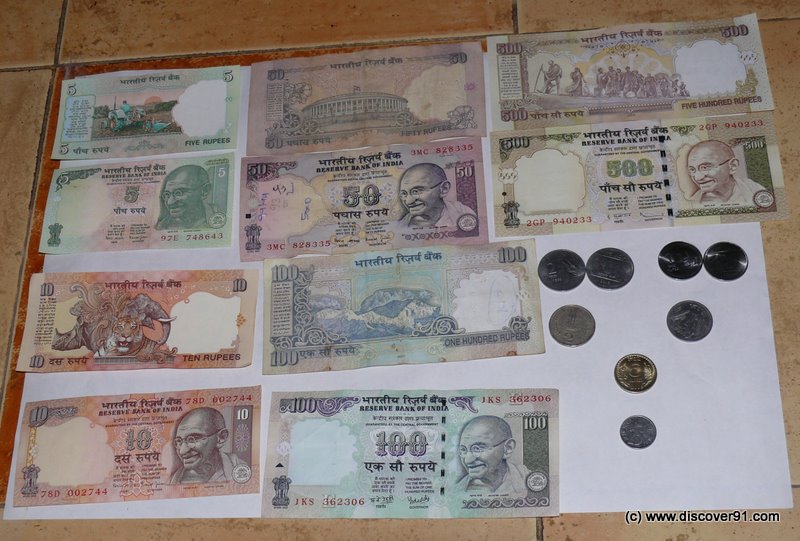
Coins
Indian Rupee coins currently in circulation are 50 paise, 1 Rupee, 2 Rupees, 5 Rupees, 10 Rupees and 20 Rupees (the 20 Rupee coin was introduced in 2019). All coins of 25 paise and below were officially demonetised in 2011 and are no longer legal tender - the 50 paise coin is technically still valid but rarely seen in practice.
Notes
Currently issued notes are 10 Rupees, 20 Rupees, 50 Rupees, 100 Rupees, 200 Rupees and 500 Rupees. The old 500 and 1000 Rupee notes (pre-2016 design) were demonetised in November 2016 and are not legal tender - don't accept them. A 2000 Rupee note exists and remains technically legal tender, but it was withdrawn from active circulation in 2023 and is no longer issued by ATMs, so you're unlikely to encounter one.
All major Indian cities have easily accessible Automatic Teller Machines. All towns and cities have many banks where you can change Travellers checks, US Dollar, Euro and other currencies. Credit cards are widely accepted in all cities, usually for amounts greater than Rs. 250 or so.
Here is the alphabetical list of all the major banks in India, with links to the respective bank website.
List of banks in India